How to Lead When You're the Only Woman in the Room: 6 Things I Learned Running a Men's Hockey Team
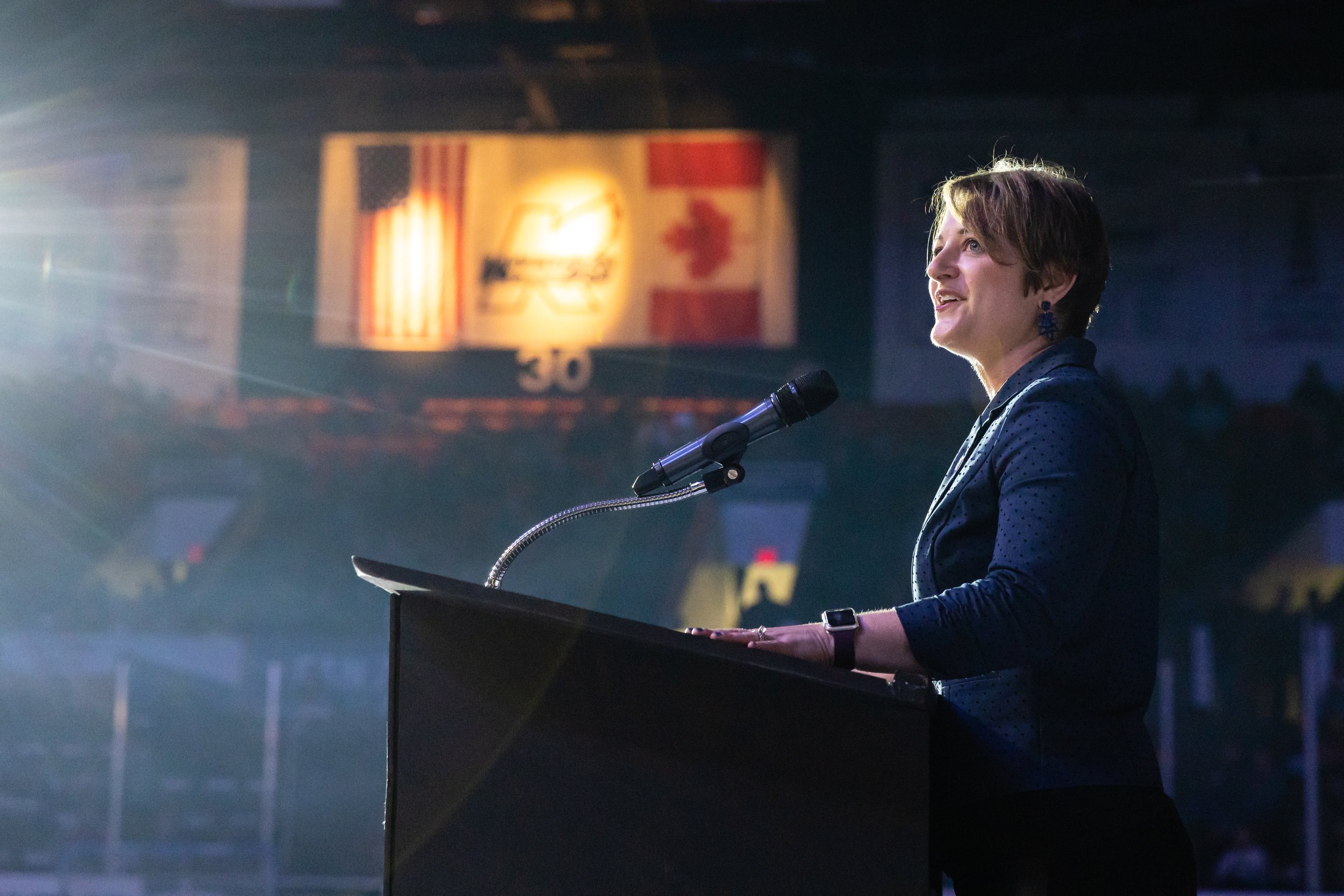
There are moments in your career when you become acutely aware that you're different.
Maybe you're the only woman in the meeting. The only woman on the leadership team. The only woman at the conference table. You look around the room and realize there isn't anyone who looks quite like you or has walked the same path.
I've spent much of my career in those rooms.
Professional hockey is one of them.
Over the years, people have asked me what it's like to lead in a male-dominated industry. The truth is, the job itself isn't the hard part. The hard part is navigating all the assumptions, both from others and from yourself.
After more than a decade leading a men's professional hockey team, here are six things I've learned.
1. Competence Is the Fastest Way to Build Confidence
When you're the only woman in the room, it can feel like you're carrying the burden of representation. You don't just want to perform well. You want to prove that you deserve to be there in the first place. I felt that pressure early in my career in professional hockey. I thought I needed all the answers, all the expertise, and complete confidence before making decisions.
What I learned is that confidence doesn't show up first. Competence does.
Confidence is built through preparation, curiosity, and repetition. It comes from asking questions, reading, listening, making mistakes, and learning from them. Over time, people don't remember whether you had all the answers on day one. They remember whether you were willing to learn, whether you did your homework, and whether you consistently showed up and delivered. The fastest way to become more confident is not to wait for confidence to magically appear. It's to get to work.
2. Stop Trying to Be "One of the Guys"
For a long time, I thought fitting in meant adapting to the environment around me. Many women in male-dominated industries do this. We become less outspoken, second-guess our instincts, soften our communication, or try to lead in a way that feels more acceptable to those around us.
Eventually, I realized that leadership isn't about becoming another version of what already exists.
Some of my greatest strengths as a leader are qualities I once questioned. Empathy. Relationship-building. Curiosity. The ability to see situations from multiple perspectives. These qualities have allowed me to connect with people, navigate difficult conversations, and build trust in ways that are uniquely my own.
The goal was never to become one of the guys.
The goal was to become fully myself.
3. You Don't Have to Attend Every Fight You're Invited To
When you're different, people notice. Occasionally you'll hear comments, encounter assumptions, or find yourself in situations that feel unfair. Early in my leadership journey, I thought I needed to respond to everything. I believed every comment needed correcting and every slight deserved a reaction.
I don't believe that anymore.
Leadership requires discernment. Some issues need to be addressed directly. Others can be handled through education and conversation. And some simply are not worth your energy. One of the most important lessons I've learned is that energy is finite. Every battle you choose to fight costs you something.
Before reacting, I now ask myself a simple question:
Is this a hill I'm willing to die on?
Sometimes the answer is yes. If it involves your values, integrity, or something that will materially impact your team or organization, then lean in and have the difficult conversation.
But often, the answer is no. Sometimes people are having a bad day. Sometimes assumptions are rooted in ignorance rather than malice. Sometimes it's simply not worth carrying the emotional weight of the fight.
The question isn't, "Can I win this argument?" The better questions are, "Is this a hill I'm willing to die on?" and "Is this worthy of my time and attention?"
Protect your energy. You need it for the things that matter most.
4. Relationships Matter More Than Titles
Sports are a people business.
So is leadership.
Over the years, I've learned that titles open doors, but relationships sustain careers. People don't follow leaders because of a title on a business card. They follow people they trust.
Trust is built in the small moments. Following through on what you said you would do. Being prepared. Having difficult conversations with honesty and kindness. Showing up consistently. Admitting when you don't know something and being willing to ask for help.
The opportunities I've had throughout my career have almost always come through relationships and reputation. Those things are built slowly, one interaction at a time. In the end, people may forget your title, but they rarely forget how you made them feel.
5. Leadership Requires Unlearning
I think one of the hardest parts of leadership for women isn't learning new skills.
It's unlearning old beliefs.
Many of us were taught to be agreeable, avoid conflict, keep everyone happy, and wait until we felt completely ready before raising our hand for an opportunity. We learned to seek permission, apologize frequently, and prioritize everyone else's comfort before our own.
Leadership asks us to do something entirely different.
Leadership asks us to make decisions with incomplete information. To set boundaries. To say no. To have uncomfortable conversations. To trust our instincts. To disappoint people at times. And perhaps most difficult of all, to stop asking for permission to take up space.
The women I know who have grown the most as leaders are the ones who have been willing to let go of beliefs that no longer serve them.
6. Being Different Is a Leadership Advantage
For years, I viewed being the only woman in the room as something I had to overcome.
Now I see it as one of my greatest advantages.
Different experiences create different perspectives. Different perspectives lead to better questions, more thoughtful decisions, and stronger teams. If everyone around the table thinks the same way, sees the world the same way, and approaches challenges from the same angle, innovation suffers.
The very thing that makes you feel different may be the thing your team needs most.
I don't believe organizations become stronger despite diversity of thought and experience. I believe they become stronger because of it.
There is a quiet confidence that comes from no longer trying to blend in. You stop trying to prove you belong in the room and instead focus on contributing in a meaningful way.
You realize that your job isn't to become more like everyone else.
Your job is to bring something to the room that nobody else can.
If you're the only woman in the room right now, I hope you remember this: your value is not in how well you blend in with the people around you. Your value is in the perspective, experiences, and leadership only you can bring.
You don't have to earn your seat every single day.
You already have one.
Now use it.