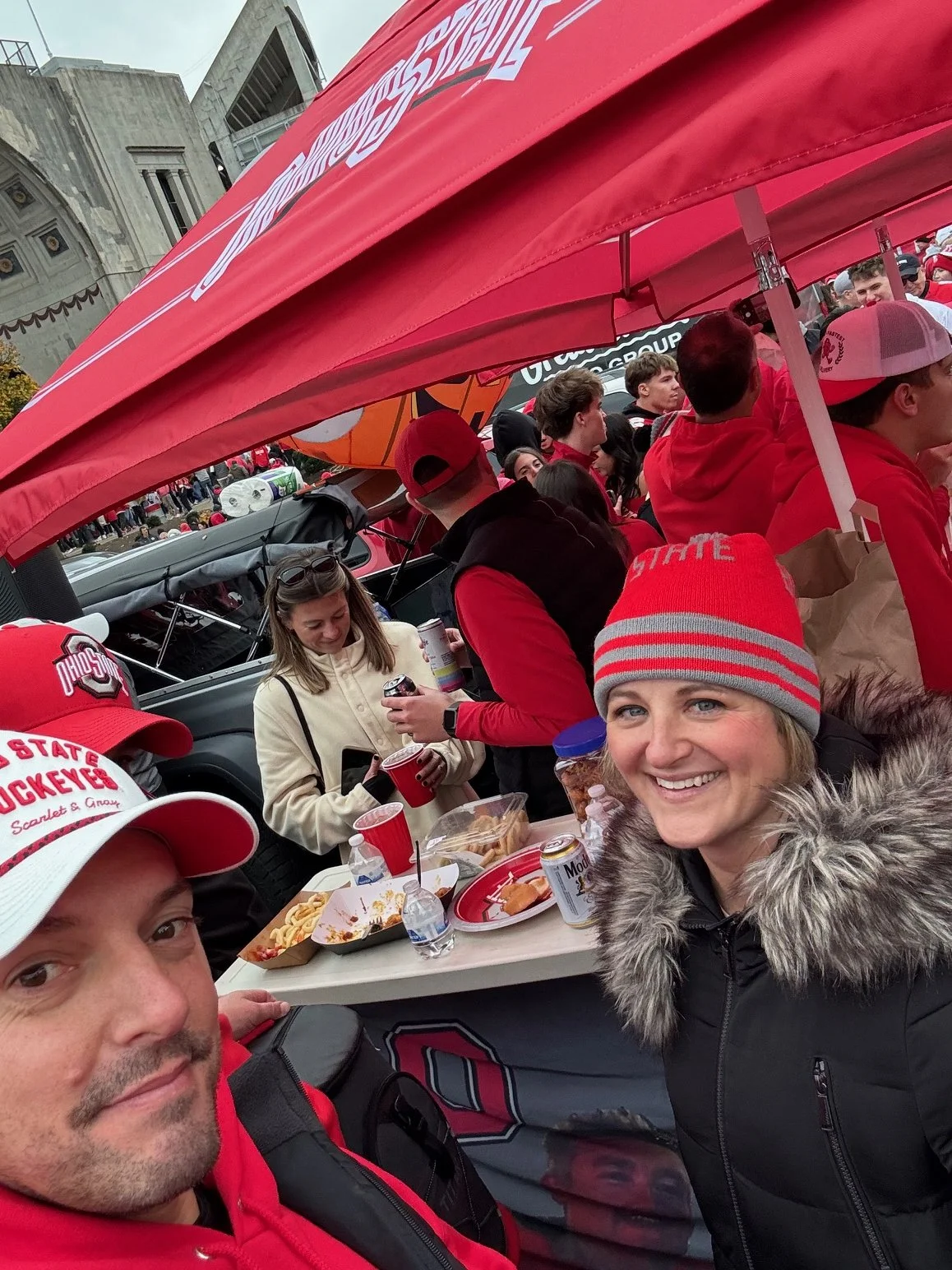
I went tailgating at Ohio State on November 7th.
Now, if you know me, you might be wondering why on earth I would voluntarily put myself in that situation. Quite frankly, I was wondering the same thing.
Being totally Toni here, I really didn't want to go.
First, tailgating has never been my thing. Even back when I drank alcohol, the idea of spending an entire day standing around drinking before a football game wasn't particularly appealing to me. Second, I'm not really a college football fan. Third, I knew I'd be surrounded by alcohol. LOTS of alcohol. Finally, and perhaps most challenging for someone like me, there was absolutely no game plan.
I'm a planner. I like knowing where we're going, what we're doing, and when we're leaving. Tailgating at a major college football game is pretty much the opposite of all those things.
But here's the deal. Marriage is about compromise, and sometimes that means doing something your partner enjoys even when it's not exactly your cup of tea. Lord knows Josh has attended his fair share of K-Wings games over the years. So off to Columbus we went.
You know what?
I had a really good time.
Not because I suddenly developed a love for college football or discovered that tailgating was my new favorite pastime. Neither happened.
I had a good time because I allowed myself to experience the day without needing it to be something other than what it was.
We walked. A LOT. I reframed all that wandering around as a fantastic opportunity to get some exercise. I enjoyed being outside, spending time with Josh, and experiencing an atmosphere that was clearly meaningful to thousands of people.
I also did a whole lot of observing.
When you're alcohol-free in an environment where drinking is practically woven into the experience, you notice things.
I watched people of all ages drinking, laughing, celebrating, and enjoying themselves. Some were clearly having a great time. Some were drinking far more than others. I saw what appeared to be underage drinking. I saw people who seemed to have been drinking for hours before the game even started.
And I saw people who weren't drinking at all. People like me.
Here's what's interesting. I wasn't standing there judging anyone. I wasn't mentally calculating how much alcohol people had consumed or feeling superior because I wasn't participating.
I was simply observing.
There was a time when being in that environment would have made me incredibly uncomfortable. Not because I didn't know how to socialize, but because alcohol had become such a familiar part of how I experienced certain situations.
When I first stopped drinking, I genuinely wondered whether I would ever feel comfortable attending events like this again.
Would I be bored? Would I feel left out? Would everyone else be having more fun than me? Would I spend the entire day wishing I could drink?
Those questions were very real in the beginning. Six years later, I can stand in the middle of one of the most alcohol-forward environments imaginable and feel completely comfortable with my decision not to drink.
Does that mean I want to spend every weekend tailgating? HECK NO.
But I don't have to avoid the experience simply because alcohol is present. That realization got me thinking about something much bigger than college football. It got me thinking about the difference between wanting to change and actually changing.
The Day I Didn't Want to Quit
Let's rewind to October 2020.
I was approximately two weeks into what was supposed to be a 30-day break from alcohol. Fourteen days. If you've never tried to stop doing something that has become deeply ingrained in your daily life, two weeks might not sound like much. But when you're counting every single day, fourteen days can feel like an eternity.
I remember sitting at our kitchen island with Josh, absolutely ugly crying. Not a few tears rolling down my cheeks. I'm talking about the kind of crying where you can barely get the words out.
I was frustrated. I was exhausted. I was overwhelmed. And I remember how badly I DIDN'T want to quit drinking. I wanted the break to be easier. I wanted the cravings and mental negotiations to disappear. I wanted to stop thinking about alcohol all the time. More than anything, I wanted to feel normal.
At that point, I was relying heavily on willpower. Every day felt like another negotiation with myself. I had committed to thirty days, and I was determined to follow through, but that didn't mean I liked it.
I certainly wasn't sitting there thinking, "Wow, this is amazing! I can't wait to live the rest of my life without alcohol!" Quite the opposite. I was thinking about how much longer I had to go.
Here's the part I want you to understand.
I didn't want to quit drinking. But I was already not drinking.
Those two things were happening at the exact same time. Looking back, I think that's one of the most important lessons from my entire alcohol-free journey.
You Don't Have to Want to Quit to Quit
We have this idea that meaningful change begins with some dramatic moment of clarity.
That one day we'll wake up and suddenly WANT to stop drinking, start exercising, leave the unhealthy relationship, change careers, or finally address whatever habit has been holding us back.
We'll feel ready. Motivated. Excited, even. Then we'll make the change. Wouldn't that be nice. Unfortunately, that's not how it works for a lot of us.
Sometimes we make a decision before our emotions have caught up. Sometimes we know something isn't serving us, but we still enjoy parts of it. Sometimes we want the benefits of changing without wanting to give up the behavior itself. Sometimes we simply don't know what life will look like on the other side.
That was me in October 2020.
I didn't have some grand vision of becoming an alcohol-free coach, speaking about my experience, or incorporating alcohol-free leadership into my professional work.
I wasn't planning to be alcohol-free six years later. I was just trying to get through thirty days.
That's it.
I hadn't committed to forever. I hadn't decided alcohol would never again be part of my life. I certainly hadn't figured out how to navigate weddings, vacations, holidays, sporting events, or all the other occasions where alcohol had traditionally been present.
I was simply practicing a different behavior. One day at a time. Somewhere along the way, something started to shift.
Your Behavior Can Change Before Your Mindset Does
I think we put an enormous amount of pressure on ourselves to feel differently before we allow ourselves to act differently.
We tell ourselves we need to be motivated before we exercise. We need to feel confident before we apply for the promotion. We need to be completely ready before we make a major life decision.
But what if we've got that backward? What if the action comes first?
When I started my thirty-day alcohol break on October 12, 2020, my behavior changed immediately. I stopped consuming alcohol.
My thoughts, feelings, habits, and beliefs about alcohol? Those took a whole lot longer.
I still associated alcohol with relaxation, celebration, connection, and reward. I still had moments when I wanted a drink. I still questioned whether I really needed to be doing this.
Changing the behavior didn't instantly erase years of conditioning. But it gave me something incredibly valuable.
The opportunity to experience life differently.
Every alcohol-free day provided new information. I learned I could have a difficult day at work without pouring a drink afterward. I learned I could attend social gatherings without alcohol. I learned that some of the situations I thought required a drink actually didn't.
I also learned that not every alcohol-free experience was going to be magical.
Sometimes things were uncomfortable. Sometimes I was bored. Sometimes I wished I could participate the way I used to. That's part of the process, too.
Over time, my emotional relationship with alcohol began to change because I was giving myself opportunities to build a different one. I wasn't waiting until I wanted to stop drinking. I was learning what happened when I did.
Hold the Decision Loosely, but Take the Action Seriously
Something I've shared with coaching clients over the years is the importance of giving yourself permission to experiment.
You don't have to decide what you're going to do for the rest of your life. You can decide what you're going to do today. Or for the next seven days. Or thirty.
For some people, the thought of never drinking again is so overwhelming that they don't even attempt a break. Forever feels too big. So don't start with forever.
Start with something manageable. Take the break seriously, but give yourself permission not to have all the answers.
You can be committed to your current decision without knowing what your future decisions will look like. That's exactly what I did.
To this day, I don't typically describe myself as someone who "quit drinking." I took a thirty-day break on October 12, 2020. I haven't picked up a drink since.
That distinction might seem like semantics, but for me, it matters. It removes the pressure of having to make some enormous declaration about the rest of my life. Instead, I get to continue choosing the life I'm building.
I also want to acknowledge something important. For people who are physically dependent on alcohol, suddenly stopping can be medically dangerous. Professional medical guidance may be necessary before taking a break. There is no shame in getting support, and there is certainly no prize for trying to do everything through willpower alone.
Six Years Later, I'm Still Learning
Standing in the middle of that Ohio State tailgate, surrounded by people drinking, I couldn't help but think about the woman sitting at her kitchen island in October 2020.
The woman who was crying because fourteen days without alcohol felt so incredibly hard. The woman who wasn't sure she could make it to thirty. The woman who didn't WANT to quit.
I wish I could go back and tell her a few things. I'd tell her that it gets easier. I'd tell her that she doesn't have to figure it out forever. I'd tell her that she's going to discover things about herself she never anticipated. I'd tell her that one day she'll be standing at a college football tailgate, surrounded by alcohol, not wanting a drink, and actually enjoying herself.
Not because she's white-knuckling her way through the day. Not because she's proving something to anyone. Simply because alcohol no longer needs to be part of the experience. That's a pretty remarkable change from where I started.
It didn't happen because I woke up one morning desperately wanting to quit drinking. It happened because I started practicing a different way of living, even when part of me resisted it.
Maybe You Don't Have to Be Ready
If you've been thinking about changing your relationship with alcohol, here's what I hope you'll take away from these two stories.
You don't have to hate alcohol to question its place in your life. You don't have to hit rock bottom. You don't have to know whether you'll ever drink again. You don't even have to WANT to quit.
You can be curious. You can be reluctant. You can be frustrated. You can have mixed feelings about the entire thing. You can miss something while simultaneously discovering that your life is better without it.
All of those things can be true.
The woman crying at the kitchen island and the woman enjoying herself at an Ohio State tailgate are the same person. The difference is six years of experiences, choices, lessons, and growth.
So if you're waiting for the day when you suddenly feel completely ready to change, consider this:
Maybe you don't have to want to quit to quit. Maybe you just have to be willing to see what happens when you don't pick up.
You might be surprised by who you become.